
Most trips start in the city of Cairo, a city many choose to underplay. Instead of a whirling two-day Egypt travel itinerary, one outdoorsy connoisseur recommends: Spend half your day at the Giza Plateau (or longer if you want to go into the Great Pyramid or take your time around the Sphinx without being rushed). Now the Egyptian Museum is a completely different visit. You could be there for four hours and not see everything worth seeing
Key Takeaways
- Cairo deserves more time than most travelers give it.
- The Giza Plateau alone can consume half a day, or more if you plan to enter the Great Pyramid.
- The Sphinx is best experienced without a time crunch.
- The Egyptian Museum is a multi-hour visit; four hours may still not be enough to see everything worthwhile.
Most people get this wrong. They plan their Egypt itinerary according to what appears to be a good idea on paper: three days in Cairo, one day in Luxor, a brief visit to Aswan, and then complain about the hurried feeling of that trip. The Egyptian sites are not quick tick-boxes. A few pick you up and bring you to a halt most unexpectedly.
That feeling is avoidable. Optimism does not belong in a well-built Egypt travel itinerary, only accuracy. With that in mind, let’s take a site-by-site look at what actually makes sense.
Cairo: A Few Days, Minimum 3 Full
Most trips start in Cairo, a city many choose to underplay. Instead of a whirling two-day Egypt travel itinerary, one outdoorsy connoisseur recommends: Spend half your day at the Giza Plateau (or longer if you want to go into the Great Pyramid or take your time around the Sphinx without being rushed). Now the Egyptian Museum is a completely different visit. You could be there for four hours and not see everything worth seeing.
Another half day at least would be required for Old Cairo with its Coptic churches and Khan el-Khalili bazaar. A three-day stay in Cairo is not too much time. That’s about as low as it gets for a first-time visitor who wants to go home not with bragging rights or expectations, but at least having something.
Luxor: Two Days, Not One
Each side of the Nile in Luxor is worthy of a day on its own, as Luxor divides itself into two banks.
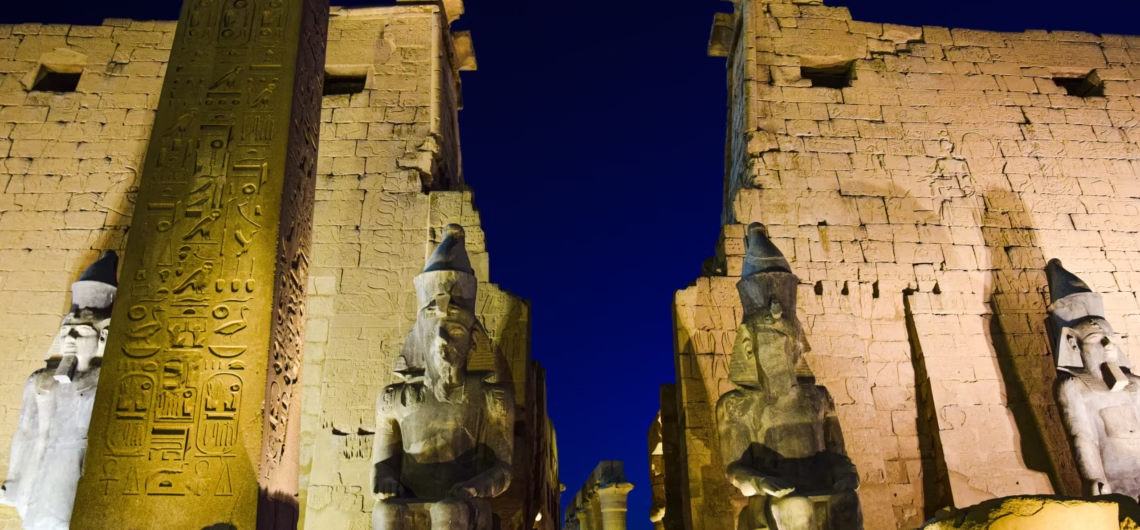
Karnak Temple and Luxor Temple are both on the East Bank. Karnak is genuinely large. On its own, it takes two to three hours to walk the entire complex, including the Avenue of Sphinxes and the Hypostyle Hall.
The Valley of the Kings, as well as the Temple of Hatshepsut and the Colossi of Memnon, are all located on the West Bank. Note that visits to the tombs are ticketed separately, with some tombs having a cap on visitor numbers. One of the largest travel oversights people make is rushing this part of Luxor.
Aswan: One To Two Days
That slower rhythm is intrinsic to Aswan’s charm: it doesn’t move at the pace of Cairo or Luxor. There are three main sites which you will visit: Philae Temple, the Unfinished Obelisk, and the High Dam. These are done in a non-stressful way over an entire day.
If Abu Simbel gets on your must-see list, that’s a completely separate day. Located roughly 280km south of Aswan, most visitors get there by flying or taking an early-morning convoy. If you came to Egypt for ancient temple architecture, the extra day is well worth it.
Putting It Together
An example of what a realistic Egypt travel itinerary for your first-time visit looks like:
Cairo: 3 days
Luxor: 2 days
Nile Cruise: 3 to 4 nights
Aswan: 1 to 2 days
Abu Simbel: 1 Day (optional but highly recommended)
That lands you right around 10–12 days total. Trips can be shorter, but something needs to get cut from the itinerary. Having clarity about what you’d sacrifice before you book makes for a much clearer planning process.
Featured image source: https://images.pexels.com/photos/18934607/pexels-photo-18934607.jpeg